




ATTENZIONE. D’ORA IN POI PER ACCEDERE A QUESTO BLOG UTILIZZARE SOLO L’INDIRIZZO
HTTPS://KURVENAL.WORDPRESS.COM
Prologo…
Cast
Regista Tobias Kratzer
Direttore Nathalie Stutzmann
Tannhäuser Klaus Florian Vogt
Elisabeth Elisabeth Teige
Venus Ekaterina Gubanova
Wolfram von Eschenbach Markus Eiche
Landgraf Hermann Günther Groissböck
Biterolf Olafur Sigurdarson
Reinmar von Zweter Jens-Erik Aasbø
PS Sono costretto ancora una volta a segnalare che commenti “anonimi” e non inviati ai “commenti” dei posts sono immediatamente cassati
(Giovanni Neri 78)


A coloro che leggono il blog chiederei cortesemente la registrazione (che non comporta nulla). Così facendo riceveranno un e-mail tutte le volte che un nuovo post è pubblicato.
PS Un “blogger” non è un oracolo e commette inevitabilmente errori (il minimo possibile..). Ricevo spesso “correzioni” non sempre fondamentali e non sempre precise. Così come io mi sottopongo al giudizio altrui con nome e cognome così chi vorrà avere la bontà di segnalarmi eventuali errori o imprecisioni dovrà farlo unicamente mandando un commento: a ognuno la propria responsabilità. In base alla nuova normativa chi si fosse iscritto e desidera de-iscriversi è sufficiente che mi invii un messaggio e-mail..
————————————————————————————————————————————————————————
Prologue
Dear Ms. Wagner
after a few years I attended a show again at the Festspielhaus, the Tannhäuser. It is not my intention to discuss the opera and its staging here, but to propose some general considerations. The theater, since the time of Richard Wagner, has undergone many transformations to adapt it to the spirit of the times. Just to name a few: changes to the structure, change of lights, projection of films etc. Even around the building there have been many changes: no longer ladies in long dresses, fracks and tuxedos but a series of stands from village festivals with bratwurses, rivers of beer etc. Modernization, whether you like it or not. It is therefore not clear why in all these transformations the well-being of the spectators has not also been thought of. The “armchairs”, if they can be called that, are torture, with the backrest painfully sticking into the back so much so that cushions are made available in the wardrobe that only partially alleviate the torture. The narrowness of the seats and the absence of armrests lead to unpleasant contact with neighbors. Would changing (for the better) the seats be a sacrilege? And I come to the second point. In all theaters around the world, surtitles are made available to prevent the public, including Germans, from not understanding the text of what is sung, so important in Wagnerian opera, as repeatedly emphasized by his great-grandfather Richard. Attending a work without being able to understand the text is reminiscent of what happened before the Second Vatican Council where the faithful attended the Latin Mass without understanding what the priest pronounced. Is it possible that only in Bayreuth and in Bayreuth it happens? Or is it a clumsy attempt to hide from the viewer the discrepancy between the sung text and a scenography often very far from the dictate of the composer? Perhaps in this perspective it should be remembered that the success of the Festspielhaus is no longer what it used to be and tickets are no longer snapped up: asking why would be wise. Dear Madam, everyone wants to be remembered for what they have done in the course of their lives: do you want to be remembered above all for omissions and not for successes? A loyal Wagnerian
G.Neri
Review
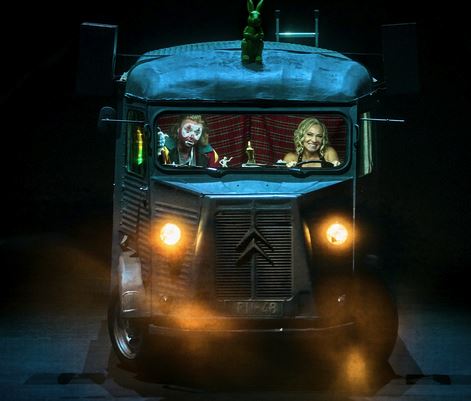
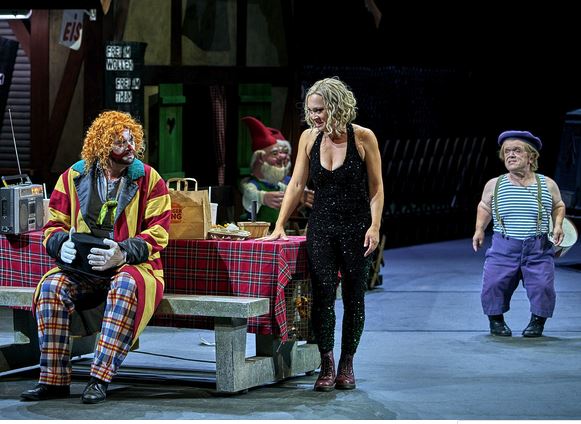
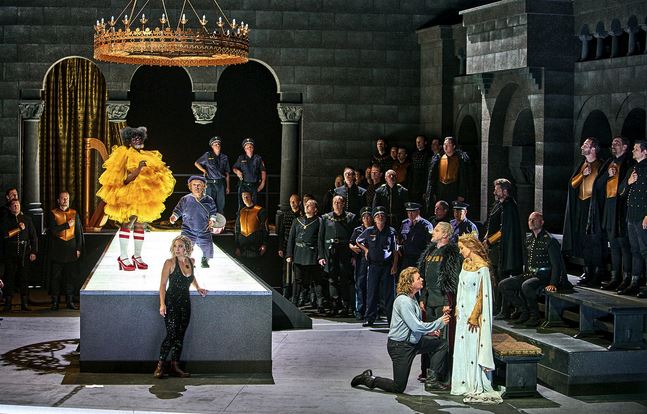
To interpret this direction by Tobias Kratzer of Tannhäuser, we must forget the words “sacredness” and “myth”. Here the direction transports the whole story to an earthly level where the action forgets to a large extent the Wagnerian text and develops a narrative that only remotely recalls the story, rewarding instead the directorial acrobatics in which Kratzer is a master. Only in this perspective can you enjoy a show that desecrates the plot of the work and transforms it into an opportunity for visual and sensory enjoyment. So the incipit shows us a Venus driving a van with which, together with the dwarf of the tin drum and a drag queen, she fills up petrol by running away without paying, steals a hamburger and knocks out a policeman who tries to stop her. Tannhäuser at his side has his face painted like that of a clown, perhaps to indicate that his spirituality has completely vanished. The Venusberg is represented by the gingerbread hut of Hansel and Gretel. The dwarf of the tin drum and the drag queen accompany Venus throughout the story (which receives all the sympathy of the audience). The singing contest. The three bizarre companions approach the place of contention, which – coincidentally – is the Festspielhaus watched by grim guardians. With a ladder they reach the balcony and then split up brandishing a sign that praises freedom of thought and action. Meanwhile, the backstage and the control room are projected on a screen. Venus overpowers one of the choristers who attend the fight: on her way to the bath, she takes possession of her wig and dress and returns to her place in the hall of contention. This is followed by some tasty and funny scenes in which Venus behaves like a Tannhâuser football fan until she invades with her teammates, after the irreverent and provocative performance, the tribune of the fight to celebrate her champion. Venus vs. Elisabeth two to null. The third act takes place in a devastated suburb where a billboard praises the drag queen stands out and with the van of the first act in ruins from which the dwarf emerges. Wolfram – finally! – he has Elisabeth blatantly in the van. The unforgiven Tannhâuser arrives and does not find his way to the Venusberg despite the presence of a Venus climbing the billboard. Elisabeth in the meantime has committed suicide in the van and her body is extracted by the two and laid on the lap of the redeemed Tannhäuser in a pose reminiscent of Michelangelo’s piety. Salvation through the sacrifice of a woman as in Fliegende Hollander. Curtain. In the performance I witnessed thunderous applause and no protest from an audience that packed the hall to the last seat. So it is if you like. In a context like this, it is difficult to examine the musical aspect. Excellent direction by Nathalie Stutzmann who, despite the set design did not help her, was able to render the entire warp of the opera with exceptional mastery. Excellent voices as Tannhäuser, Klaus Florian Vogt and as Wolfram von Eschenbach, Markus Eiche. And a particular applause also for the stage presence at Venus of Ekaterina Gubanova, Much less brilliant Elisabeth Elisabeth Teige who was unable to render the labor of the protagonist. All the other singers at normal level.
PS I would kindly ask the readers of this blog to register (which implies nothing) which can be easily made by “clicking” the black square above each post. By so doing they will receive an e-mail message whenever a new post is published.
PS A “blogger” is not an oracle and inevitably makes errors (the minimum possible..). I often receive “corrections” not always fundamental and not always accurate. Just as I submit myself to the judgement of others with the name and surname so those who want to have the goodness to report errors or inaccuracies will have to do so only by sending a comment: everyone has his own responsibility.

Per un elenco aggiornato di tutti i precedenti posts di questo blog con i corrispondenti links

Leggete anche i commenti ai posts selezionando il bottone “commenti” sulla sinistra del post. Talvolta sono persino più interessanti del post stesso!!!
PS Vorrei ringraziare tutti coloro che inseriscono commenti ai posts utilizzando l’opzione “Lascia un commento” (o “commenti” se ne sono già stati inseriti) prevista nella sezione sinistra (o prima del testo per schermi ridotti come i tablets) dei posts stessi affinchè tutti possano leggerli. Il dibattito è sempre interessante per tutti…..grazie (è indispensabile lasciare nome e cognome – i commenti anonimi non saranno pubblicati)!!
 Kurvenal: le recensioni musicali
Gentile Professore , chiunque avesse disapprovato la messa in scena sarebbe stato tacciato di omofobia, transfobia e …fascismo. anzi, dato il luogo, nazismo.
Quindi, si questi tempi, meglio astenersi.
"Mi piace""Mi piace"
Mi associo pienamente alla lettera per la signora Wagner,ma
dubito ne tenga alcun conto.Del resto dovremmo anche suggerirle
di non proporre ulteriormente sventurate regie, che snaturano l’Opera di Wagner.Due anni fa ho assistito al peggiore Gotterdammerung che potessi mai immaginare con la regia di tale Valentin Schwartz.sono rimasto afono per esprimere il mio disappunto ( insieme alla maggioranza del pubblico).
Quest’anno Parsifal e Tannhauser
mi hanno lasciato silenzioso e ho applaudito solo la
interpretazione musicale cosi come del nuovo Tristan und Isolde… spostato in un magazzino o… era la stiva di una nave?)
Occorre decriptare le intenzioni dei registi per poter apprezzare lo spettacolo?
"Mi piace""Mi piace"