





Ci risiamo! .. Here we go again….
… Il regista istraeliano Yuval Sharon firma la regia di un secondo Zauberflöte alla Staatsoper in un solo anno. Che dire? Siamo alle solite. Registi che anziché valorizzare un’opera (compito difficile) si rifugiano in mezzucci di facile digestione. Normalmente questa opera è un complesso insieme colorato di opera seria, opera buffa e recitativi. Qui invece ci troviamo sostanzialmente di fronte a una edizione per bambini con tanto di marionette Tutto quello che concerne il pathos sacrale e il tormento dei protagonisti non interessa questo regista. Il mondo è qui rappresentato come un Manga, i protagonisti sono sagome appese a fili come nel teatro delle marionette e al contempo figure da playstation, i dialoghi sono spesso recitati da voci infantili e per sottolineare il tutto il finale è rappresentato da un teatro delle marionette i cui fili sono tenuti da bambini. Uno spettacolo che certamente piace ai più giovani ma lascia perplessi i cultori dell’opera che percepiscono come una grossa parte del suo significato venga a mancare.
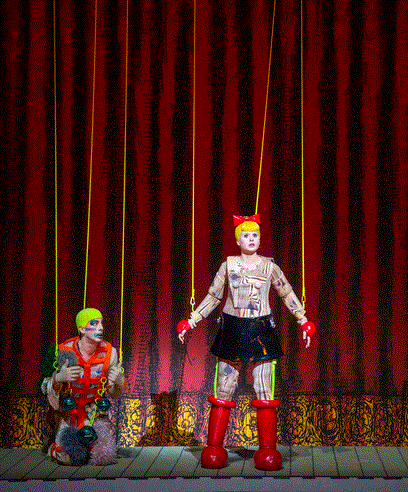
I poveri protagonisti debbono cantare fluttuando in aria sorretti da fili e agghindati con moon-boots che difficilmente trovano una giustificazione. Una trovata che non corrisponde in alcun modo allo spirito dell’opera e che soprattutto riduce tutto a una esibizione da circo, forse come l’aveva pensata Schickaneder ma certo non Mozart. E le trovate da avanspettacolo come il bicchiere di vino richiesto da Papageno (una figura in cartapesta con il vino in cartapesta che simbolizza il liquido) e addirittura l’entrata in una cucina del XX secolo dei protagonisti, una volta superate le prove, sono di gusto semplicemente pessimo. Così come pessimo è il vestito (se così si può chiamare) della Papagena: una sorta di vedo-e-nonvedo composto da strisce che – fra l’altro- poco si addicono alla figura che lo indossa. E che dire di Monostato agghindato e che si muove come 3-B-O di Stars War?
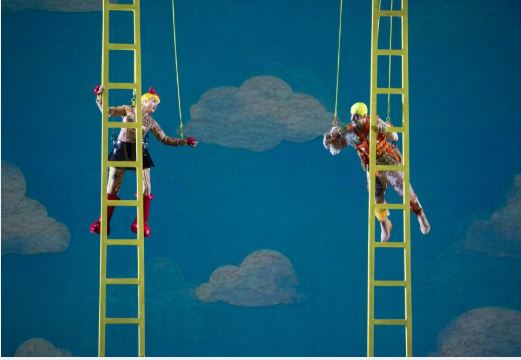
Tamino (Julian Prégardien) è un ottimo tenore che meriterebbe ben altra sceneggiatura. Lo stesso dicasi di Tamina (Serena Sáenz) . Del tutto insufficiente invece la prestazione di Nicola Proksch come regina della notte, una voce che manca di autorevolezza, incerta nella intonazione e con evidente problemi nei sopracuti. Papageno (Florian Teichtmeister) eccelle più nell’aspetto istrionesco che nella voce. Ottima invece la prestazione di Jan Martiník come Sarastro,(l’unico non legato ai fili delle marionette). voce profonda e di grande spessore. 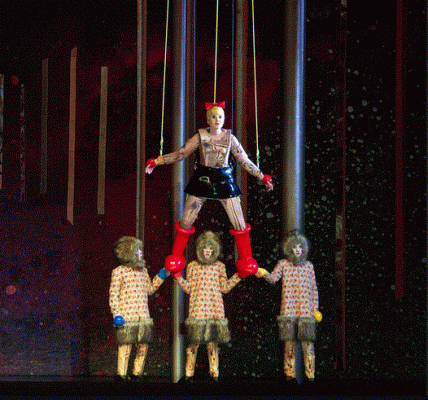
Nella norma gli altri protagonisti con una menzione assolutamente positiva per i tre fanciulli, bravi nella perfetta intonazione e anche perfettamente a loro agio dal punto di vista scenico. Quanto alla direzione di Alonda de la Parra va rimarcato la sua scelta di evitare alla Staatskaeplle il vibrato, gli accenti sforzati e la scelta di una concertazione da musica antica che un poco è in contrasto con la scenografia . Alla direzione manca un fraseggio ampio e il contenimento dell’orchestra non giova. Un buon, non eccezionale, successo. (Giovanni Neri)
A coloro che leggono il blog chiederei cortesemente la registrazione (che non comporta nulla). Così facendo riceveranno un e-mail tutte le volte che un nuovo post è pubblicato.
PS Un “blogger” non è un oracolo e commette inevitabilmente errori (il minimo possibile..). Ricevo spesso “correzioni” non sempre fondamentali e non sempre precise. Così come io mi sottopongo al giudizio altrui con nome e cognome così chi vorrà avere la bontà di segnalarmi eventuali errori o imprecisioni dovrà farlo unicamente mandando un commento: a ognuno la propria responsabilità. In base alla nuova normativa chi si fosse iscritto e desidera de-iscriversi è sufficiente che mi invii un messaggio e-mail.
____________________________________________________________________________________________________________________________________________________________________________
… The Israeli director Yuval Sharon signs the direction of a second Zauberfiöte at the Staatsoper in a single year. What about it? It’s the usual. Regisseurs who instead of iinterpreting a text (difficult task) take refuge in tricks of easy digestion. Normally this work is acomplex of serious opera, opera buffa and reciting work. Here, however, we are basically faced with a children’s edition with puppets Everything that concerns the sacred pathos and the torment of the protagonists does not interest this director. The world is represented here as a Manga, the protagonists are silhouettes hanging from wires as in the puppet theater and at the same time playstation figures, the dialogues are often recited by childish voices and to emphasize the whole the end is represented by a puppet theater whose wires are kept by children. A show that certainly pleases the younger ones but leaves perplexed the lovers of the work who perceive how a large part of its meaning is lacking. The poor protagonists must sing floating in the air supported by wires and wrapped with moon-boots that hardly find a justification. A gimmick that in no way corresponds to the spirit of the opera and that above all reduces everything to a circus performance, perhaps as Schickaneder had thought but certainly not Mozart. And you can find it in the glass of wine requested by Papageno (a papier-maché figure with papier-maché wine that symbolizes the liquid) and even the entrance into a kitchen of the twentieth century of the protagonists, once they pass the tests, are of just awful taste. Just as bad is the dress (if you can call it that) of the Papagena: a kind of see-and-notsee made of stripes that – by the way – little befit the figure that wears it. Tamino (Julian Prégardien) is a very good tenor who would deserve more better direction. The same is true of Tamina (Serena Saenz). Totally insufficient Nicola Proksch’s performance as queen of the night, a voice that lacks authority, is uncertain in intonation and with obvious problems in the “sopracuti”. Papageno (Florian Teichtmeister) excels more in histrios appearance than in voice. Jan Martinok’s performance as Sarastro (the only one not tied to the puppet wires) was excellent. A deep and thick voice. In the norm the other protagonists with an absolutely positive mention of the three children, with perfect intonation and also perfectly comfortable from the stage point of view. As for the direction of Alonda de la Parra, it should be emphasized her choice to avoid at the Staatskaeplle the vibrato, the churned accents and the choice of a concertation from ancient music that is somewhat at odds with the scenery . The direction lacks a broad phrasing and the containment of the orchestra does not help. A good, not great, success.
(Giovanni Neri)
PS I would kindly ask the readers of this blog to register (which implies nothing) which can be easily made by “clicking” the black square above each post. By so doing they will receive an e-mail whenever a new post is published.
PS A “blogger” is not an oracle and inevitably makes errors (the minimum possible..). I often receive “corrections” not always fundamental and not always accurate. Just as I submit myself to the judgement of others with the name and surname so those who want to have the goodness to report errors or inaccuracies will have to do so only by sending a comment: everyone has his own responsibility.

- Musical director Alondra de la Parra
- Director Yuval Sharon
- Set Design Mimi Lien
- Costumes Walter Van Beirendonck
- Light Reinhard Traub
- Videodesign Hannah Wasileski
- Sound design Markus Böhm
- Sarastro Jan Martiník
- Tamino Julian Prégardien
- Pamina Serena Sáenz
- Papageno Florian Teichtmeister
- Papagena Álfheiður Erla
- Königin der Nacht Nicola Proksch
- Sprecher David Oštrek
- Monostatos Florian Hoffmann
- Drei Damen Adriane Queiroz , Natalia Skrycka , Constance Heller
- Erster Geharnischter Jun-Sang Han
- Zweiter Geharnischter Frederic Jost,
- Erster Priester Andrés Moreno García
- Zweiter Priester David Oštrek
- Drei Knaben Solisten des Tölzer Knabenchores


 Kurvenal: le recensioni musicali